Showing posts with label Pavilions. Show all posts

Wednesday, 1 December 2010

Movie by Spirit of Space: South Pond by Studio Gang

South Pond Pavilion by Studio Gang

Architectural filmmakers Spirit of Space have sent us this video of a pavilion situated in Chicago’s Lincoln Park Zoo, designed by US architects Studio Gang.

The movie shows the construction of the bent-wood lattice structure, the installation of fibreglass shells to the top of the pavilion providing shelter and its various uses throughout day and night.

South Pond Pavilion by Studio Gang

Studio Gang Architects also designed the boardwalk surrounding the 19th century pond, improving the water quality and habitat for the local wildlife and creating an educational nature trail.

South Pond Pavilion by Studio Gang

The new pavilion is used as an outdoor classroom, for yoga sessions and other activities.

South Pond pavilion by Studio Gang

Here a little more from Studio Gang:


South Pond
Lincoln Park Zoo
Chicago, USA

The project transforms a picturesque urban pond from the 19th century into an ecological habitat buzzing with life.

South Pond pavilion by Studio Gang

With the design’s improvements to water quality, hydrology, landscape, accessibility, and shelter, the site is able to function as an outdoor classroom in which the co-existence of natural and urban surroundings is demonstrated.

South Pond Pavilion by Studio Gang

A new boardwalk circumscribing the pond passes through various educational zones that explicate the different animals, plants, and habitat found in each.

South Pond Pavilion by Studio Gang

A pavilion integrated into the boardwalk sequence provides shelter for open-air classrooms on the site.

South Pond Pavilion by Studio Gang

Inspired by the tortoise shell, its laminated structure consists of prefabricated, bent-wood members and a series of interconnected fiberglass pods that give global curvature to the surface.

South Pond Pavilion by Studio Gang

Architect: Studio Gang Architects
Owner: Lincoln Park Zoo
Status: Completed 2010

Rubber House by Zeinstra van Gelderen architecten

Rubber House by Zeinstra van Gelderen architecten

Dutch architects Zeinstra van Gelderen architecten have designed this one-man pavilion made entirely of rubber.

Rubber House by Zeinstra van Gelderen architecten

The Rubber Pavilion is entered though a slit and has a bench in one wall and a window frame, which cannot be seen through, in another.

Rubber House by Zeinstra van Gelderen architecten

The entire pavilion including the bench and window frame are formed from resin poured into a mold.

Rubber House by Zeinstra van Gelderen architecten

The pavilion will be on display at the Museum Bahnsteig in Oberhausen, Germany from Wednesday 25 August until the 1 October, and then will sit in front of the Schauspielhaus in Bochum from 4 to 8 October.

Rubber House by Zeinstra van Gelderen architecten

Here’s some more from the architects:


“I have often thought that probably there might be a way found out to make an artificial glutinous composition much resembling that excrement out of which the silk worm wire-draws his clew” Robert Hooke, 1664

The Rubber House is a small pavilion, completely made out of rubber. The house can be entered, one person at a time, to retreat from the outside and to find oneself again. The introvert character of the pavilion is reinforced by the hollow acoustics of the interior. Partly translucent walls enlighten the space during the day Unlike what you might expect, the Rubber House is all about mass and weight.

Rubber House by Zeinstra van Gelderen architecten

The house is an amber-coloured rectangular monolith (outside dimensions 1,5x 1,5 x 2,3 m) in which an egg shaped interior seems to be carved out. One wall offers a small bench and another a window-frame with no view. The entrance is nothing more than a vertical cut in a third wall. The whole house, including bench and window-frame, is made out of poured in place urethane resin.

Rubber House by Zeinstra van Gelderen architecten

The Rubber House will be the main source of inspiration for a performance by the dramaturg Tjyying Liu in the first week of October 2010 on the square in front of the Schauspielhaus Bochum. Before that, it will also be on display in Oberhausen as part of the ISEA2010 conference, the International Symposium on Electronic Art. From August 25 till October 1 it will be on display at the Museumbahnsteig in Oberhausen. The Rubberhouse has been made possible by a grant from the Fonds BKVB

(the Netherlands Foundation for Visual Arts, Design and Architecture) and is produced by ‘Anything is Possible’, Amsterdam

Tuesday, 30 November 2010

Sports Pavillion by MoederscheimMoonen

Sports Pavillion by MoederscheimMoonen Architects

This pavilion with illuminated eaves was designed by Dutch firm MoederscheimMoonen Architects for two football teams in Rotterdam.

Sports Pavillion by MoederscheimMoonen Architects

The sports pavilion forms part of Park 16Hoven, a new residential suburb of the city.

Sports Pavillion by MoederscheimMoonen Architects

The two-storey building has dressing rooms and storage on the ground floor covered by turf mounds, which slope down to meet the pitch surface on the northern side.

Sports Pavillion by MoederscheimMoonen Architects

The clubhouse and boardrooms on the upper storey overlook the pitches, with the grassy slopes forming a natural grandstand.

Sports Pavillion by MoederscheimMoonen Architects

The roof extends on all sides and is illuminated at night by LEDs.

Sports Pavillion by MoederscheimMoonen Architects

All photographs are by Rob ‘t Hart.

Here’s some more from the designers:


Sports-pavilion in Rotterdam by MoederscheimMoonen Architects

MoederscheimMoonen Architects recently delivered a new sports-pavilion for two soccer clubs in Rotterdam, The Netherlands. The project is part of the development of Park 16Hoven; a large new suburban neighborhood adjacent to the city center and the airport.

Sports Pavillion by MoederscheimMoonen Architects

Within the open space between the airport and newly developed houses in the park, the aim for the design was to create a transparent and ‘lightweight’ pavilion.

Sports Pavillion by MoederscheimMoonen Architects

The building is set up in two levels. The clubhouses and the boardrooms are situated on the top floor of the building. This level is directly connected to the pitches by grass-covered slopes.

Sports Pavillion by MoederscheimMoonen Architects

These slopes cover the ground floor with its dressing rooms and storage areas, and provide a natural grandstand for spectators.

Sports Pavillion by MoederscheimMoonen Architects

The final piece of the building is the translucent cantilevered roof. This roof filters direct sunlight and illuminates like a lampoon in the evening thanks to the integration of LED powered lighting.

Sports Pavillion by MoederscheimMoonen Architects

The building is iconic in its direct environment due to the continuous outline of the building and the illuminated roof.

Sports Pavillion by MoederscheimMoonen Architects

Architect: MoederscheimMoonen Architects
Location: Rotterdam, The Netherlands
Project Architect: Erik Moederscheim
Project Team: Erik Moederscheim, Ruud Moonen, Jelle Rinsema
Engineering: Bureau Bouwkunde

Sports Pavillion by MoederscheimMoonen Architects

Structural Engineering: IBT Bouwtechniek
General Contractor: Batenburg BV
Client: Municipality of Rotterdam
Gross floor space: 1410 sqm
Photography: Rob ‘t Hart

Sports Pavillion by MoederscheimMoonen Architects


Flockr by SO-IL

Dezeen architecture and design magazine

Flockr by SO-IL

October 8th, 2010

Flockr by SO-IL

This temporary pavilion with reflective purple scales that shimmer in the breeze has been installed in Beijing by New York architects SO-IL.

Flockr by SO-IL

The pavilion – created as the main hub for the arts festival Get it Louder - was constructed in four days and will be dismantled and transported to Shanghai for the second leg of the festival.

Flockr by SO-IL

Photographs are by Iwan Baan.

Here’s some more information from SO-IL:


TWO TEMPORARY STRUCTURES BY SOLID OBJECTIVES – IDENBURG LIU OPEN IN BEIJING AND NEW YORK

Solid Objectives – Idenburg Liu (SO – IL), winner of the 2010 MoMA PS1 Young Architects Program, has opened two temporary structures in Beijing and New York. SO-IL’s ”Flockr” pavilion serves as the central hub for “Get It Louder,” a biannual media and arts event taking place in Beijing through October 10th and in Shanghai October 22nd to November 7th. In New York, SO – IL was one of the winners of Sukkah City, a competition to design a small ritual shelter traditionally associated with the Jewish holiday Sukkot. SO-IL’s entry “In Tension” was displayed on Union Square in Manhattan on September 19th and 20th, and the project will be featured at the Center for Jewish History in New York until October 15th.

Flockr by SO-IL

“We believe the importance of ephemeral architecture will increase in this prolonged era of uncertainty. The economic environment has become so unpredictable that short-term, low-cost projects are the most feasible. Yet this kind of project can also offer a perfect testing ground for larger scale work,” says SO-IL partner Florian Idenburg. “Temporary projects require a particular mindset. You have to quickly grasp the local condition and provide a lean and elemental solution that provides a sense of specificity— a fleeting mark—even if only for an instant.” The two projects reflect SO-IL’s interpretation of the distinctive moods of contemporary Beijing and New York, the latter more contemplative and considered, the former full of energy and gusto.

Flockr by SO-IL

Flockr Pavilion for Get It Louder Get It Louder, an acclaimed biannual media and arts festival sponsored by Modern Media of China, features a series of lectures, screenings and exhibitions by over one hundred Chinese and foreign designers, artists, writers and filmmakers. Organized by an international team including Chinese curator and writer Ou Ning and design writer Aric Chen, this year’s theme “SHARISM” focuses on the relationship between public and private realms in the digital age. SO-IL was commissioned to design Get It Louder’s main pavilion, which serves as a central hub for the event and houses many of the festival’s activities.

Flockr by SO-IL

SO – IL conceived the “Flockr” pavilion as a structure that responds to its environment while also creating a sense of place through its basic form. Covered with thousands of tinted mirrored panels, the skin reflects its surroundings and makes the changing contexts of this temporary and mobile installation—the cityscapes of Beijing and Shanghai— an integral part of its expression. In SO-IL’s experimental façade, only the top of each panel is attached to the structure, allowing the individual pieces to respond to wind and creating a kinetic skin that is permeable by light and air.

Flockr by SO-IL

The pavilion’s structure is made out of 56 thin, flexible steel rods that connect at the bottom and the top into two large steel rings. The larger bottom ring frames the interior perimeter of the structure while the smaller top ring creates a skylight; the relationship between the two results in the pavilion’s curvilinear womb-like shape. The activities that take place within are gently enclosed by a dynamic pattern of thousands of flickering reflections.

Flockr by SO-IL

“Because it is circular in plan and curvilinear in section, the pavilion does not discriminate any direction,” says SO-IL partner Jing Liu. “Once passing through the entryway, the interior is generous and encompassing. “We envisioned the pavilion as a place where ideas can flock together, be projected, pass through, and be nurtured and distilled.”

Flockr by SO-IL

The structure was assembled within four days for the opening on Sept 20th and will be demounted and reinstalled within a week’s time for its use in Shanghai.

4am by dePaor Architects

4am by dePaor architects

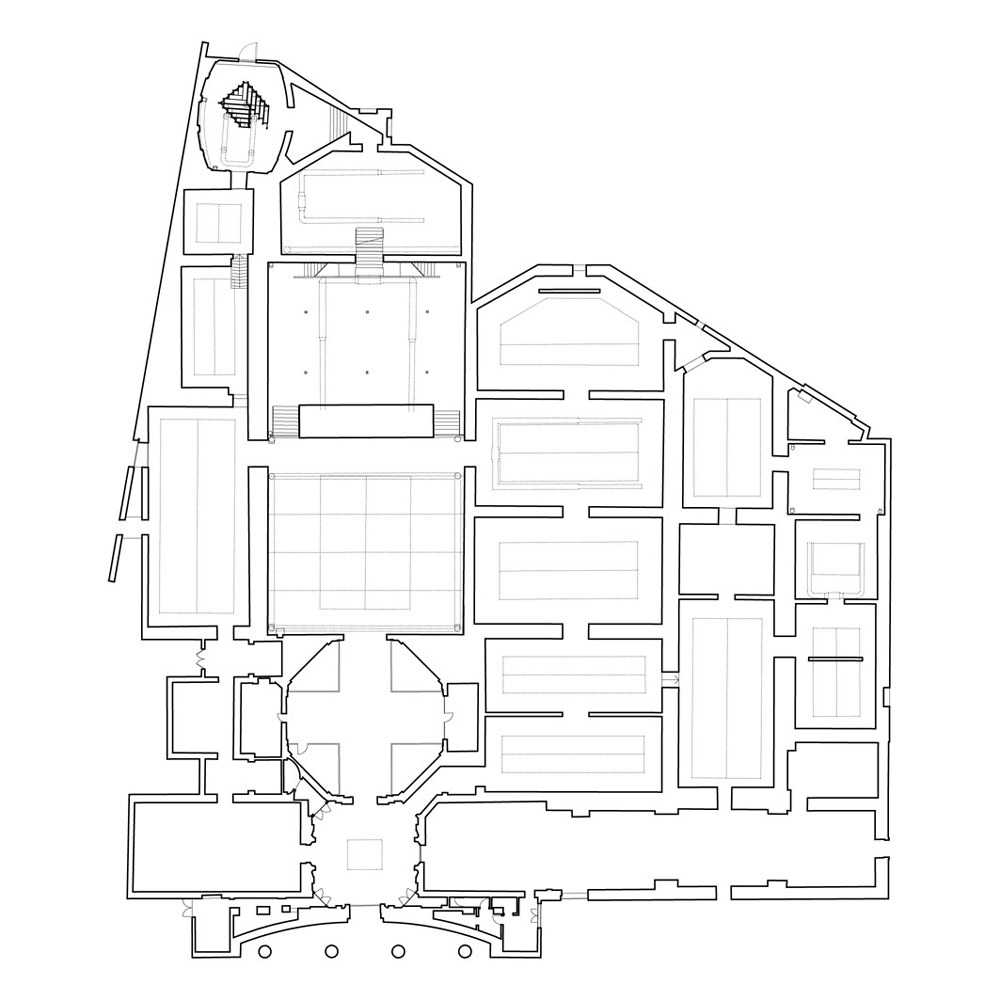
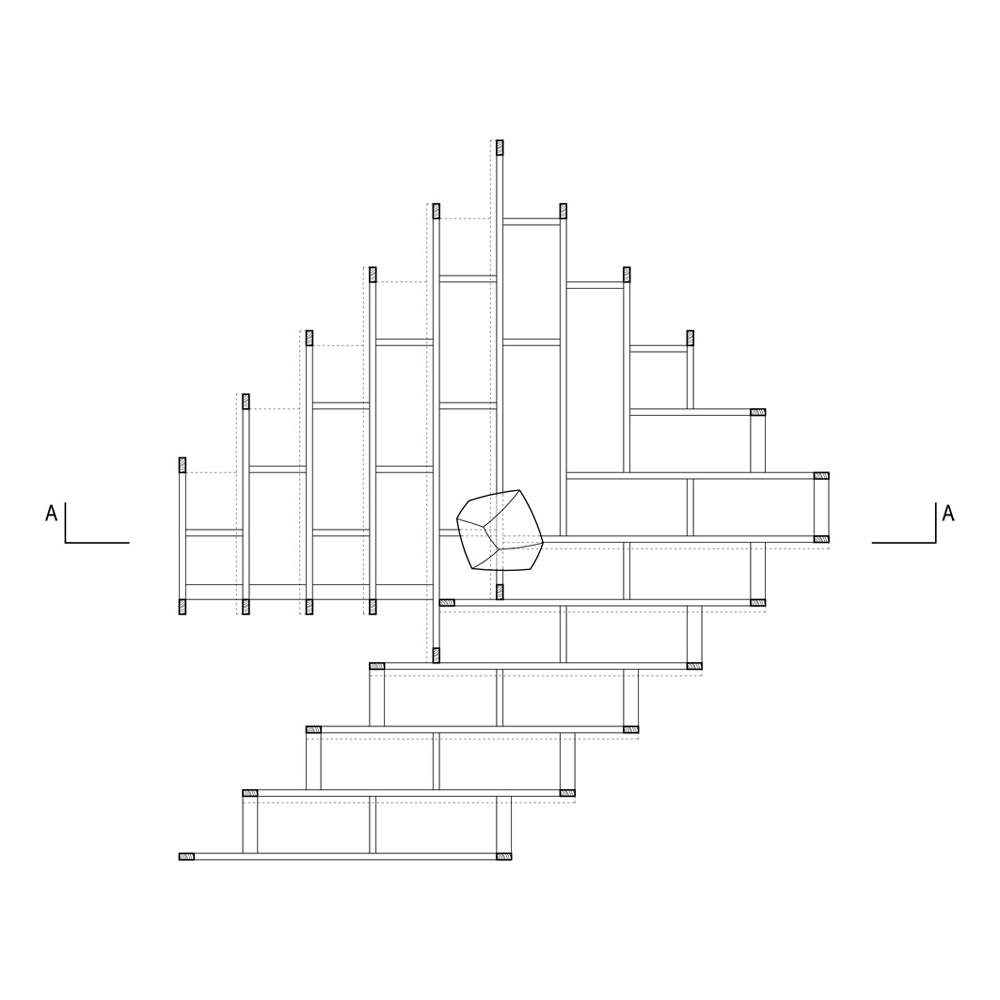
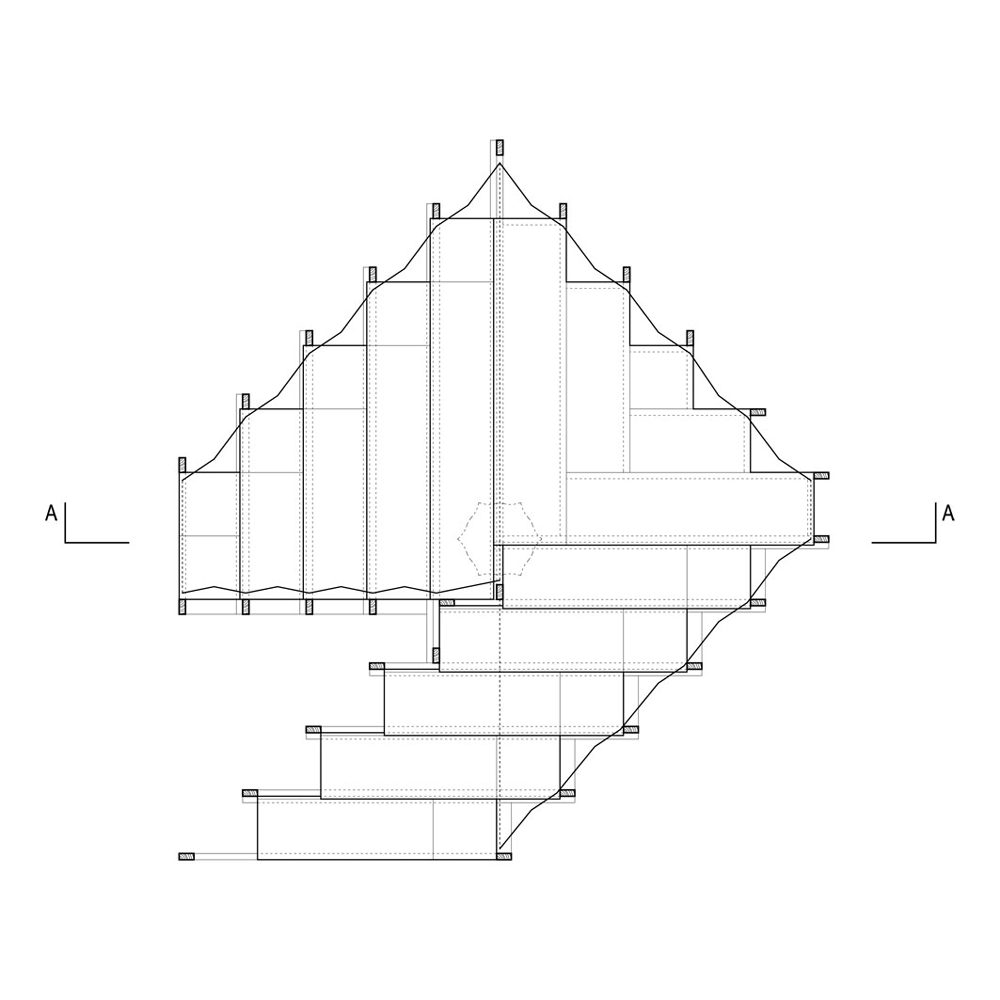
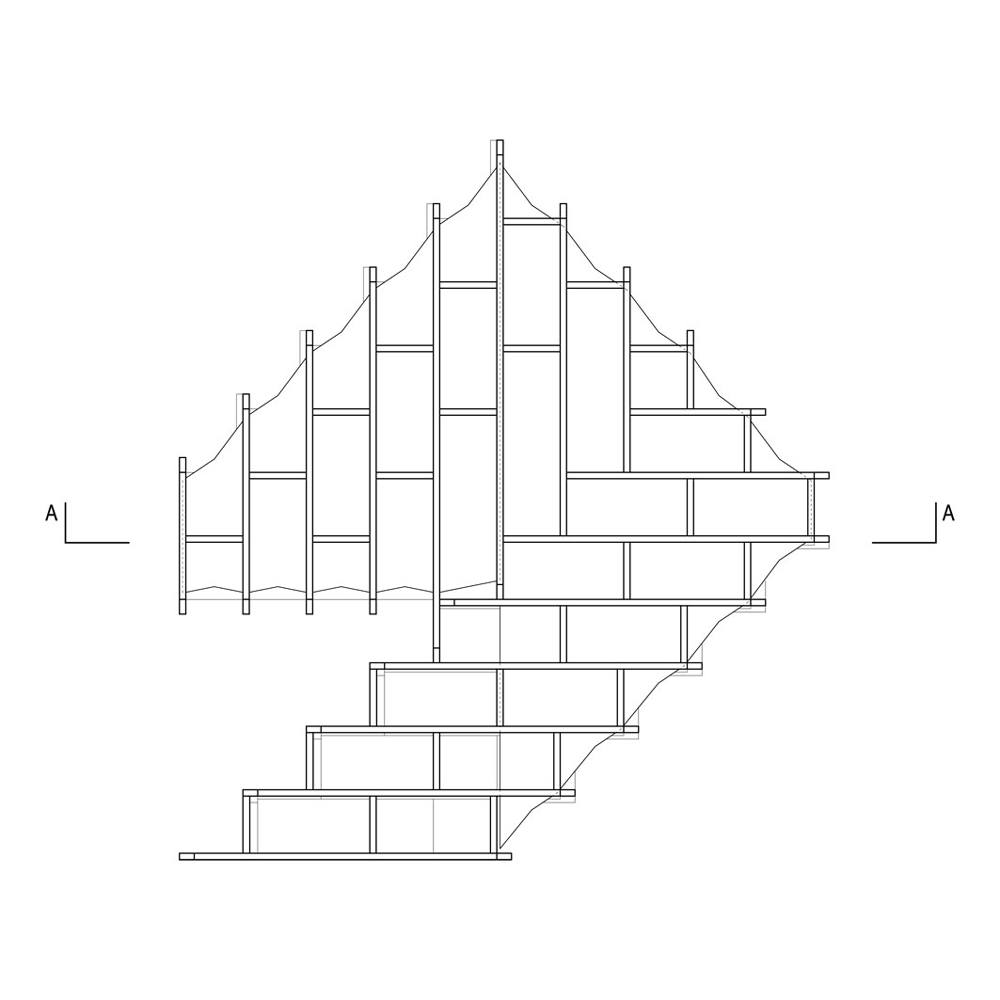
Venice Architecture Biennale 2010: this stepped wooden pavilion by Irish studio dePaor Architects is on show at the Venice Architecture Biennale.

4am by dePaor architects

Called 4am, a sheet of pleated linen covers the walls and ceiling of the scented softwood frame.

4am by dePaor architects

Visitors walk up the steps of the pavilion to a half landing, only to descend almost immediately.

4am by dePaor architects

The project was presented in the Palazzo delle Esposizioni in the Giardini of Venice.

4am by dePaor architects

The Venice Architecture Biennale continues until 21 November.

4am by dePaor architects

Photographs are by Alice Clancy.

See all our stories about Venice Architecture Biennale 2010 »

4am by dePaor architects

The following information is from the architects:


dePaor architects present a folly in pleated linen and lavendered softwood, called “4am”, in the Palazzo delle Esposizioni in the Giardini of Venice. The project constructs a liminal space, between two bespoke subject objects, as a domestic shadowplay.

‘From this point on I came to regard architecture as the instrument which permits the unfolding of a thing’ A. Rossi, ‘A scientific autobiography’

The square footprint casts the shadow of Adam’s house in Paradise. A square plan is an economical speculation beyond the vernacular, which is difficult to extend. The approach is either oblique or flat and dictates the site. A cut pyramid roof denies the gable and the small politics of front and back.

4am by dePaor architects

Reduced continuity between inside and outside multiplies the encounter between here and there. The tactic and strategy of servant and served plot the room plan. At the half landing, nothing happens.

’Transformed and displaced images, impressions, occurances which have moved me deeply (often without my knowing it), forms which I sense are closely associated with me, even though I am incapable of identifying them, which makes them all the more troubling to me.’ A. Giacometti, The Palace at 4 am

4am by dePaor architects

Drawings are copyright dePaor Architects

4am is staged between hylo and hedra, a shade and a stone after Dürer’s Melancholia I of 1514. At 4am the air duct fouls the upholstered dogleg staircase, which ascends to descend at the fire escape of the Palace. The planed and lavendered 2” x 4” softwood cribbage is glued and screwed at 400 mm centres. Beneath the transoms, the pleated 600 thread count linen closets the lambswool treads of the house at 4am.

‘The wardrobe is filled with linen. There are even moonbeams which I can unfold.’ A. Breton, ‘Revolver aux cheveux blancs’

4am by dePaor architects

credit list:
Title of the project: ’4am’
Technique: 2” x 4” planed, lavendered softwood, linen, sisal, limestone, glass
Name of studio: dePaor architects
based in: Dublin, Ireland
Name of principal: T. dePaor

4am by dePaor architects

Contributors:
architecture: A. Hofheinz
construction: R. Cullen
linen: J. Shields, K. McQuade (Classic Curtains), J. Devlin, P. Maybury
scent: D. Cox
hedra: J. Ellis
hylo: S. Walker
sisal: T.C. Matthews

4am by dePaor architects

hylo was blown at Berengo Studio, Murano
hedra was direct-carved in Dunbeakin, Co. Sligo, from Butler’s Grove limestone.
lavender was harvested at Kilmacanogue, Co. Wicklow by Fragrances of Ireland.
linen was provided by Kvadrat.

Supporters: Culture Ireland

4am by dePaor architects